The Butterfly Life Cycle!
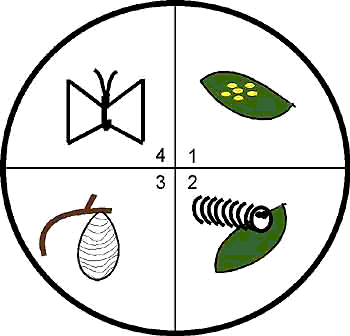
 Today I had another great experience teaching the 2nd graders. They never stop surprising me on how smart they are! Lindsay and I did a wrap up lesson on the butterfly by explaining to the students the stages in its life cycle. This was a fun lesson, because the students were able to make connections between what they have already learned so far with the new concept. Like always, the students were able to remember a lot of the information we previously taught them, which is always an assuring feeling. In order to teach the students about the life cycle, Lindsay and I decided to have the 2nd graders build a paper-plate model with pasta. We used four different types of pasta to represent the different stages: orzo for eggs, corkscrew for the caterpillar, shells for the chrysalis, and bow-tie for the butterfly. All in all the activity was successful, and we were able to somewhat incorporate the focus point of the week, which was technology and engineering. In order to incorporate technology and engineering, we found a framework that stated: 1.3 Identify and describe the safe and proper use of tools and materials (e.g., glue, scissors, tape, ruler, paper, toothpicks, straws, spools) to construct simple structures. I wish we could have better incorporated this into our lesson; we were able to have the students use some of these materials, but we should have given better instructions on how to properly use them. At times, I found students trying to put glue on their small pieces of pasta, rather than just put glue on the plate and put the pasta on top. When I saw this occur, I would go over and show the correct way of using the glue, but it would have been more beneficial if I instructed the whole class on using the tools before starting the activity. This activity had a lot of difficult steps, in which the students needed broken down.

Great use of pasta! That activity sure sounds like it would be a lot of fun, and I never really thought about how similar the different pastas look to the stages of life of a butterfly. As for the need of breaking down activites, I'm right there with you. So many times one might just think the students will automatically know the small easy steps. For example, my students had to pour soil into a container and then water right after. i never thought that I would actually have to direct the class on how they should exactly pour the water from the cups. For us, pouring water or gluing macaroni is pretty straight forward. But I guess there is a definite need for fundamental instruction at the younger levels.
ReplyDeleteI really like the way you connected the technology and Engineering framework to the lesson, creative!
ReplyDelete